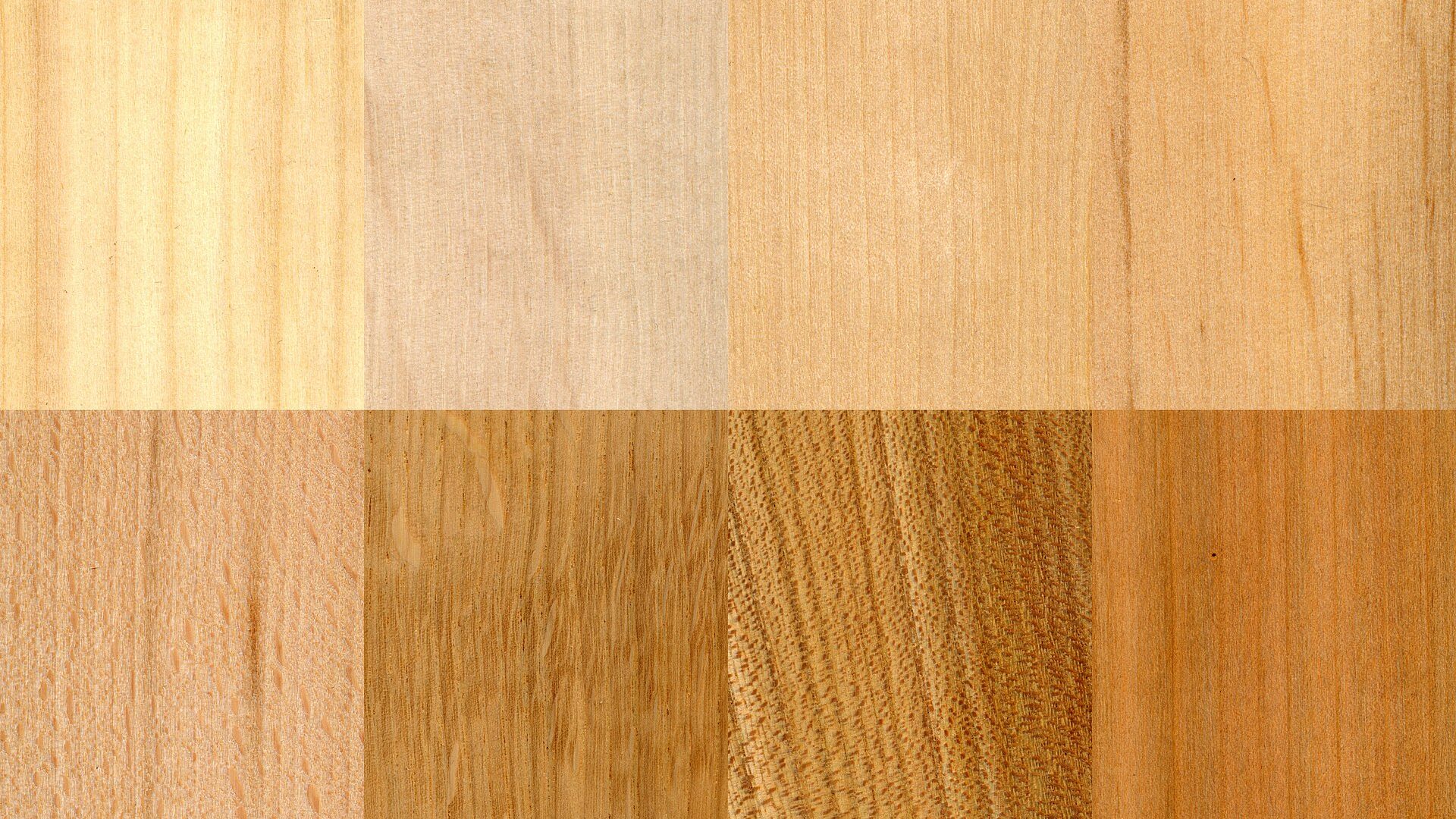
Every species we build with regularly, with the published hardness and shrinkage figures behind the recommendation — not marketing copy. Figures are drawn from the USDA Forest Products Laboratory Wood Handbook; see the movement calculator and hardness selector on the home page for the same data made interactive.
| Species | Janka hardness | Tangential shrinkage | Radial shrinkage | T/R ratio |
|---|---|---|---|---|
| Hard Maple (Acer saccharum) | 1,450 lbf | 9.9% | 4.8% | 2.06 |
| White Oak (Quercus alba) | 1,360 lbf | 10.5% | 5.6% | 1.88 |
| White Ash (Fraxinus americana) | 1,320 lbf | 7.8% | 4.9% | 1.59 |
| Teak (Tectona grandis) | 1,070 lbf | 5.8% | 2.5% | 2.32 |
| Black Walnut (Juglans nigra) | 1,010 lbf | 7.8% | 5.5% | 1.42 |
| Cherry (Prunus serotina) | 950 lbf | 7.1% | 3.7% | 1.92 |
| Honduran Mahogany (Swietenia macrophylla) | 900 lbf | 4.1% | 3% | 1.37 |
| Douglas Fir (Pseudotsuga menziesii) | 660 lbf | 7.6% | 4.8% | 1.58 |
Hard Maple Acer saccharum
Fine, tight, generally straight grain, though birdseye, curl, and quilt figure occur and are prized when they do. Pale cream to light reddish-brown.
The hardest domestic species in the atelier's racks — reserved for high-wear tabletop surfaces, butcher-block tops, and turned legs that take daily abuse.
White Oak Quercus alba
Coarse, straight grain with large medullary rays that throw a dramatic ray-fleck figure on quartersawn faces. Heartwood is light to medium brown with an olive undertone.
Closed-vessel structure makes it naturally rot- and moisture-resistant — the standard choice for quartersawn panels, trestle bases, and any piece that lives near an exterior door.
White Ash Fraxinus americana
Coarse, pronounced, almost always straight grain, similar in character to oak. Pale beige to light brown, prized for an open, energetic figure.
Exceptional shock resistance and bends cleanly under steam — the atelier's choice for bent chair backs and other steam-formed seating components.
Teak Tectona grandis
Straight to occasionally wavy grain, coarse and uneven texture, with a faintly oily feel from the natural silica and resin content that gives the species its reputation. Golden to medium brown, deepening further with age and UV exposure.
The natural oils that resist moisture uptake also resist rot and insect attack — the one species in the library the atelier will run in a piece that lives on a covered porch.
Black Walnut Juglans nigra
Generally straight grain, occasionally wavy or curly; medium texture with a soft, natural luster. Heartwood runs pale brown to a deep chocolate brown, sometimes with a purplish or grey cast, against pale, almost white sapwood.
The atelier's benchmark dining-table and case-good timber — figured crotch and burl sections are reserved for feature veneer panels.
Cherry Prunus serotina
Fine, straight, even grain and texture. Cut a light pinkish brown, cherry darkens under UV exposure to a rich reddish-brown patina over its first year or two in a room.
Favoured where an evolving, deepening patina is the point — dining tables and case pieces that are meant to look different in ten years than they do on delivery day.
Honduran Mahogany Swietenia macrophylla
Fine, generally straight grain that can run interlocked, producing a ribbon or chatoyant figure on quartered faces. Salmon-pink when freshly cut, deepening to a warm reddish brown.
One of the most dimensionally stable furniture timbers available — the atelier's default for case goods and seating frames that must hold tight joinery through every season.
Douglas Fir Pseudotsuga menziesii
Coast-type stock (Oregon/Washington, west of the Cascades) — the figures above are specific to it; interior-grown Douglas fir shrinks somewhat differently. Straight, prominent, strongly figured grain with dramatic contrast between pale, soft earlywood and darker, harder latewood bands. Light brown with a hint of red.
Softer underfoot but visually bold at scale — reserved for exposed structural millwork, staircase stringers, and paneling where the growth-ring pattern is the design feature.
Source: USDA Forest Products Laboratory, Wood Handbook — Wood as an Engineering Material (FPL-GTR-282). Hardness from the Chapter 5 side-hardness table (Janka ball test, lbf); shrinkage from the Chapter 4 Table 4-3 shrinkage table (green to ovendry, percent of green dimension). T/R ratio is computed live from the two published percentages.